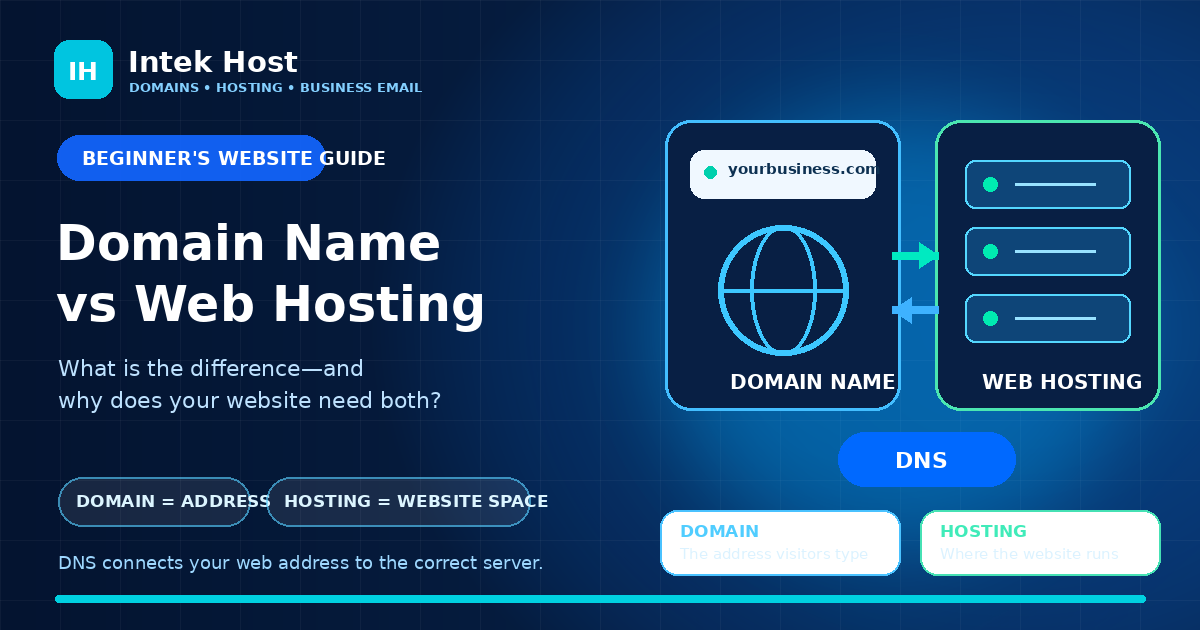
A domain name and web hosting are both important parts of putting a website online, but they are not the same service.
The simplest explanation is:
- A domain name is the address people use to find your website.
- Web hosting is the server space and technology that store and deliver the website.
For example, intekhost.net is a domain name. The pages, images, code, databases and other resources displayed when someone opens that address are delivered from web-hosting infrastructure.
Understanding the difference helps you choose the right services, avoid renewal mistakes and move your website safely when your needs change.
A simple real-world comparison
Think of a website as a business office.
- The domain name is like the office address.
- The hosting account is like the physical office where the business operates.
- The website files and database are like the furniture, documents and equipment inside.
- DNS is like a directory that tells visitors how to reach the correct office.
- Business email is another service that may use the same address but requires its own delivery settings.
The comparison is not technically perfect, but it explains why registering a domain does not automatically create a website and why buying hosting does not automatically give you the exact domain name you want.
What is a domain name?
A domain name is a unique, human-readable name used to reach an online service.
Examples include:
intekhost.netexample.comyourbusiness.com.gh
Without domain names, visitors might have to remember numerical network addresses. The Domain Name System, commonly called DNS, helps translate domain names into the technical destinations computers use.
A complete domain may contain several parts.
In shop.example.com:
.comis the top-level domain, or TLD.exampleis the registered name.shopis a subdomain.
The exact registration rules, availability and renewal conditions depend on the domain extension.
Do you permanently own a domain name?
A domain name is registered for a defined period. It is not normally purchased once and owned forever.
For many common domain extensions, registration periods may range from one to ten years. To continue using the domain, the registrant must renew it before it expires.
This is important because an expired domain can affect:
- The website
- Business email
- Customer portals
- Online payments
- Password-reset links
- Marketing campaigns
- Search visibility
- The credibility of the business
Keep the registrant contact details current, monitor renewal notices and renew important business domains early.
What do you receive when you register a domain?
Domain registration gives you the right to use the selected name for the registration period, subject to the applicable rules and agreement.
It normally gives you access to settings such as:
- Registrant contact details
- Nameservers
- Domain lock
- Renewal controls
- Transfer controls
- DNS management, depending on the provider
- Privacy options, where available and eligible
Domain registration alone does not necessarily include:
- A website
- Web hosting
- Website design
- Business email
- An SSL certificate
- A database
- Backups
- Technical maintenance
Some providers bundle additional services, so always check the exact package description.
What is web hosting?
Web hosting is a service that provides the server resources needed to publish a website or web application.
A web server stores or processes resources such as:
- HTML pages
- Images
- Stylesheets
- JavaScript files
- WordPress files
- Databases
- Videos and downloads
- Application code
- Configuration files
When a visitor opens your domain, the browser sends a request. The hosting server processes that request and returns the page or application content.
Different websites need different levels of hosting resources. A simple company website may need less storage and processing power than an online shop, news website, school platform or client-management application.
What normally comes with web hosting?
The exact features vary by provider and plan, but hosting may include:
- Website storage
- Monthly data transfer or bandwidth
- Database access
- PHP or other server technologies
- Email accounts
- SSL certificates
- Backups
- A control panel
- File-management tools
- Security features
- Technical support
- Website statistics
Never assume that every plan includes all of these. Review the current package limits and renewal terms before ordering.
How DNS connects a domain to hosting
A domain and hosting can be purchased from the same company or from different companies.
DNS connects them.
Nameservers identify the authoritative DNS service for a domain. That DNS service stores records that direct different types of traffic.
Common DNS records include:
- A record: Directs a name to an IPv4 address.
- AAAA record: Directs a name to an IPv6 address.
- CNAME record: Makes one hostname point to another hostname.
- MX record: Directs email to the correct mail service.
- TXT record: Stores text used for verification, email security and other purposes.
When someone enters your domain in a browser, DNS helps the browser find the server that should answer the request.
A DNS change may take time to be seen everywhere because records can be cached according to their Time to Live, or TTL.
Do you need both a domain and hosting?
For a normal public website, you usually need both.
You need hosting to store and serve the website. You need a domain so customers can reach it through a memorable address.
There are exceptions:
- A domain can be registered and parked without a website.
- A domain can redirect visitors to a social-media page or another website.
- A website can be tested using a temporary address.
- Some hosted platforms provide a free subdomain.
- A server can technically be reached by an IP address in some situations.
For a professional business presence, using your own domain is normally the better choice.
Can the domain and hosting be with different providers?
Yes.
Your domain registrar and hosting provider do not have to be the same company. You can register the domain with one provider and point it to hosting operated by another provider.
This arrangement works when the DNS records are configured correctly.
Keeping both services with one provider may simplify billing and support. Keeping them separate may provide more flexibility. Neither approach is automatically right for every business.
Whichever arrangement you choose, keep a record of:
- Where the domain is registered
- Where DNS is managed
- Where the website is hosted
- Where email is hosted
- The renewal date for each service
- The authorised account contacts
Can you change hosting without changing your domain?
Yes.
You can move a website to a new hosting provider while keeping the same domain name.
The usual process is:
- Set up the new hosting.
- Back up and copy the website.
- Import the database.
- Test the website on the new server.
- Prepare email and SSL where required.
- Update the necessary DNS records or nameservers.
- Monitor the website after the change.
- Keep the old hosting temporarily as a fallback.
The domain remains the same. Only the server destination changes.
Do not cancel the old hosting until the new website, email and important services have been tested.
Can you transfer a domain without moving the website?
Yes.
A domain transfer changes the registrar responsible for managing the registration. It does not have to change the website's hosting.
To prevent interruption, preserve the existing nameservers and DNS records during the transfer.
Before beginning, record the current DNS configuration and confirm that the receiving registrar will use the correct settings.
A transfer can still affect services when nameservers are changed accidentally or DNS records are not recreated properly.
Is business email part of the domain or hosting?
A domain is used in an email address, but the domain itself does not store or deliver messages.
For example:
hello@yourbusiness.com
The domain is yourbusiness.com, but an email service is still needed to receive, store and send messages.
Email delivery is controlled through DNS records, particularly MX records. Other records such as SPF, DKIM and DMARC can help mail systems authenticate messages and reduce abuse.
Business email may be:
- Included with a hosting plan
- Purchased as a separate email-hosting service
- Operated through another email provider
Before changing nameservers or DNS, preserve all email-related records. A website can continue working while email fails if the mail records are missing.
Does a domain include an SSL certificate?
Not automatically.
An SSL certificate is installed for a domain so that the website can use HTTPS. The certificate is normally issued and activated through the hosting provider, website platform or certificate service.
Many hosting plans include automated SSL certificates, but this depends on the plan.
The domain, hosting and certificate work together:
- The domain gives visitors an address.
- DNS directs the address to the hosting.
- The hosting serves the website.
- The certificate helps secure the connection over HTTPS.
Domain renewal and hosting renewal are separate
Even when the domain and hosting are purchased together, they remain separate services with their own renewal cycles.
This means:
- Renewing hosting does not always renew the domain.
- Renewing the domain does not always renew hosting.
- An unpaid hosting invoice can take the website offline while the domain remains registered.
- An expired domain can stop both the website and domain-based email even when hosting is still active.
Check every invoice carefully and make sure you understand which service it covers.
What happens when hosting expires?
The exact process depends on the provider's terms.
The website may be suspended, and access to files, databases or email may become restricted. If the service remains unpaid, the account and stored data may eventually be removed.
Keep independent backups of important website files and databases. Do not rely on an expired hosting account as your only copy.
What happens when a domain expires?
An expired domain may stop resolving correctly, which can interrupt the website and email.
Depending on the domain extension and stage of expiration, renewal or restoration may still be possible. However, recovery can become more expensive or may no longer be available.
The safest approach is to renew important domains before the expiry date.
Common mistakes business owners should avoid
Registering the domain in someone else's personal account
A developer or employee may register a business domain using an account the company cannot access.
Better approach: Ensure the business has access to the account and that the registrant information is correct.
Believing the domain and website are the same thing
A domain can remain active even when the website hosting is suspended or deleted.
Better approach: Track the domain, hosting, website and email as separate components.
Allowing the domain to expire
The website and email may stop even though the hosting invoice is paid.
Better approach: Enable renewal reminders, keep contact information current and renew early.
Changing nameservers without copying DNS records
Website, email and verification services can fail.
Better approach: Export or record the complete DNS zone before making changes.
Cancelling old hosting before a migration is complete
Files, databases or messages may be lost.
Better approach: Test the new service first and keep a final independent backup.
Choosing a domain without checking the spelling
A confusing or misspelled domain can be difficult to market.
Better approach: Choose a clear name and confirm it carefully before registration.
How to choose a good domain name
A strong business domain should be:
- Easy to spell
- Easy to pronounce
- Easy to remember
- Related to the brand
- Short enough to type comfortably
- Free from unnecessary hyphens and numbers
- Suitable for professional email
- Unlikely to be confused with another organisation
Check that the name does not improperly use another party's trademark or protected identity.
Also think beyond the first year. Review renewal pricing and the long-term suitability of the extension.
How to choose suitable web hosting
Consider the website you plan to build and the level of support you need.
Review:
- Website type
- Storage
- Traffic expectations
- Database support
- Email requirements
- SSL availability
- Backup arrangements
- Security controls
- Support channels
- Upgrade options
- Renewal price
- Resource limits
- Cancellation and suspension terms
A small brochure website may work well on an entry-level plan. A busy online shop or custom application may require more resources and specialist support.
A simple launch sequence
A business launching a new website can follow this order:
- Choose and register the domain.
- Select suitable hosting.
- Add the domain to the hosting account.
- Configure nameservers or DNS records.
- Upload or build the website.
- Create the database if required.
- Activate HTTPS.
- Configure business email.
- Test the website on desktop and mobile.
- Record the renewal dates and account details.
The domain and hosting may be ordered together, but they still perform different jobs.
Quick summary
A domain name is the online address of your website.
Web hosting provides the server resources that store and deliver the website.
DNS connects the address to the correct hosting and other services.
Business email uses the domain but requires an email service and the correct DNS records.
HTTPS requires a valid certificate for the domain and a properly configured hosting environment.
Once these roles are clear, website setup, renewals and migrations become much easier to manage.
Register your domain and host your website with Intek Host
Intek Host provides domain registration and web-hosting services for individuals, organisations and businesses in Ghana and beyond. Customers who prefer a single provider can manage their domain and hosting services through Intek Host, while those with an existing domain can connect it to a suitable hosting plan.
Search for a domain name or explore current web-hosting options.